
It was day six of a nine-day trip aboard the dive liveaboard Arenui, and we were back for a night dive at a site inside Kalabahi Bay, on the western end of Indonesia’s Alor Island. As we prepared to roll over the side, we could hear the local village Imam call the faithful to prayer – hence the inspiration for this dive site’s name: Mucky Mosque.

Underwater seascapes in this region typically feature slopes laden with hard corals that drop to depths below 100 feet, or short slopes that transition to walls beginning at 30 to 60 feet. Inside smaller bays, the bottom terrain differs greatly; in place of rich stands of coral, the landscape is dominated by rocks, dark sand, and sediment. When such a location happens to be right off the beach of the local village there will also be a wide assortment of man-made debris, from tin cans and discarded tires to tattered shirts and pants.
Muck diving is not about the scenery, it’s the host of unique and rare aquatic treasures that can be found there from ghost pipefish to an assortment of nubibranchs, flatworms, crabs and shrimps. This night, on Mucky Mosque, I was on a mission for one of the most revered “Holy Grail” of rare reef fish, Rhinopias scorpionfish. They are demersal (bottom dwelling) fish that favor habitats with a soft substrate.

There are six known species of this member of the scorpionfish family in the world, and three are found off East Nusa Tenggara Island in the Flores Island Group.
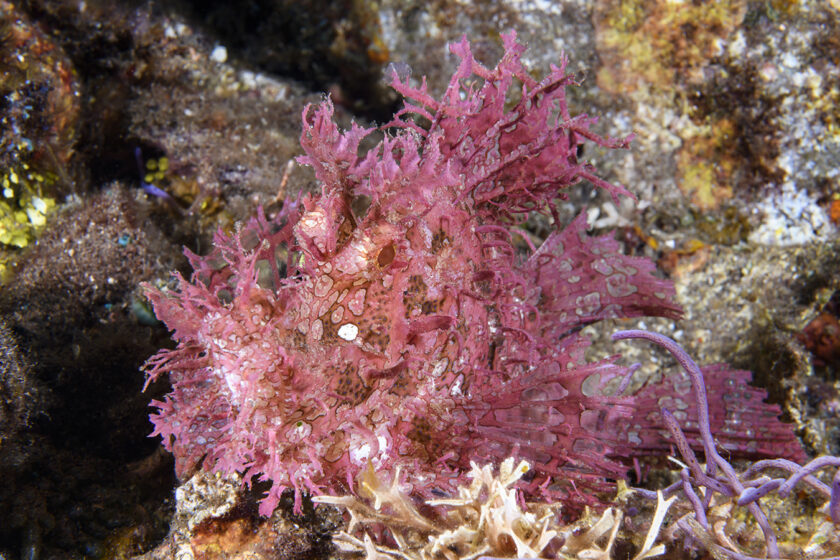
The first is Rhinopias eschmeyeri or Eschmeyer’s scorpionfish, which is most often identified as the paddle-flap scorpionfish due to large paddle shaped appendages above their eyes that look like a comical set of eyebrows. Next, Rhinopias aphanes, or Merlet’s scorpionfish. This one is more widely known as the lacy Rhinopias, due to the high number of tattered tentacles present around its jawline, eyes and across the entire length of its supraocular and rear lacrimal spines. Last, but not least is Rhinopias frondosa. AKA weedy scorpionfish, their fins and body generally sport weed like appendages like that of the lacy but also comprise distinctive dark-margined spots with a spot in the middle across the body.
As goofy as they might look between their compressed body with upturned snout, the color range of Rhinopias is the most variable among scorpionfish retaining hues from yellow and orange to red or purple.
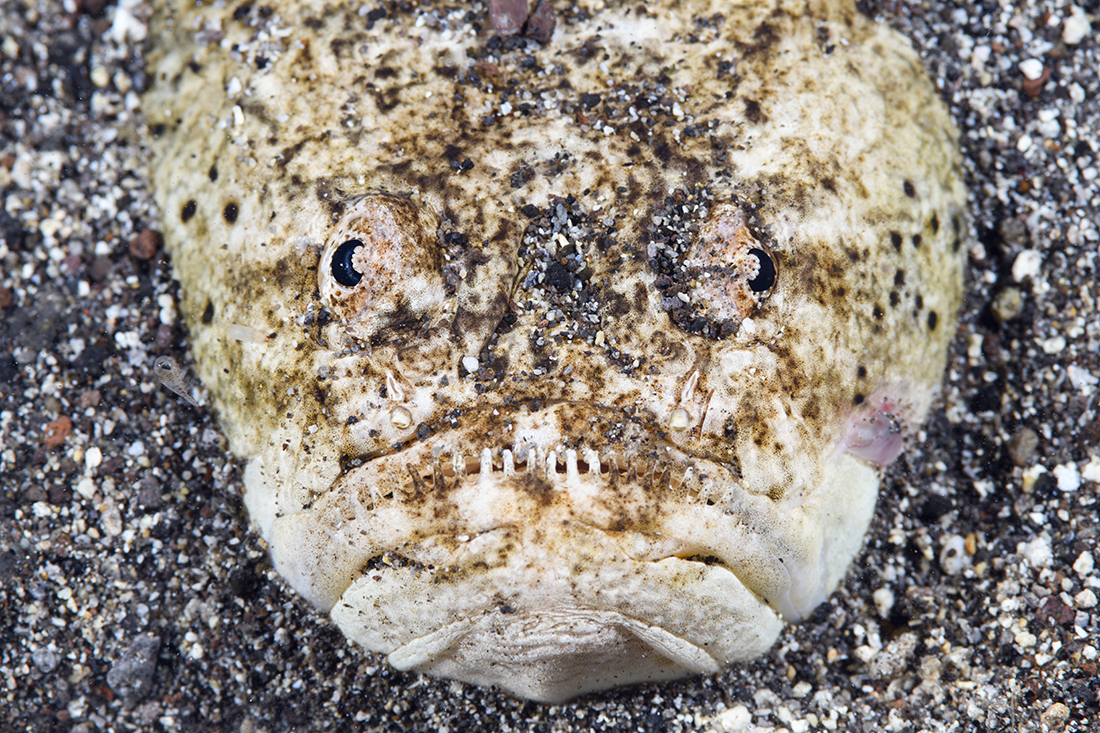
Finding Rhinopias can require a bit of finesse. The bottom composition, which generally includes silt, can easily stir up making it easy for the more cryptic critters to go unnoticed. To the untrained eye, this ‘mucky’ type of bottom will appear deceptively lifeless. Or you might happen on something that makes you think you’re seeing things, like a macabre face in the sand staring back at you. At Mucky Mosque, the face is real, belonging to a stargazer buried in the sand with only its eyes and mouth exposed to avoid advertising its position as it lays in wait to ambush passing prey.

Two days earlier I captured both an orange-hued Paddle-flap Rhinopias (R. eschmeyeri) and a lavender hued Lacy Rhinopias (R. aphanes).


Fifteen minutes into this dive it was beginning to feel like déjà vu as one of Arenui’s guides steered me to my second and third Paddle-flap Rhinopias of the trip.

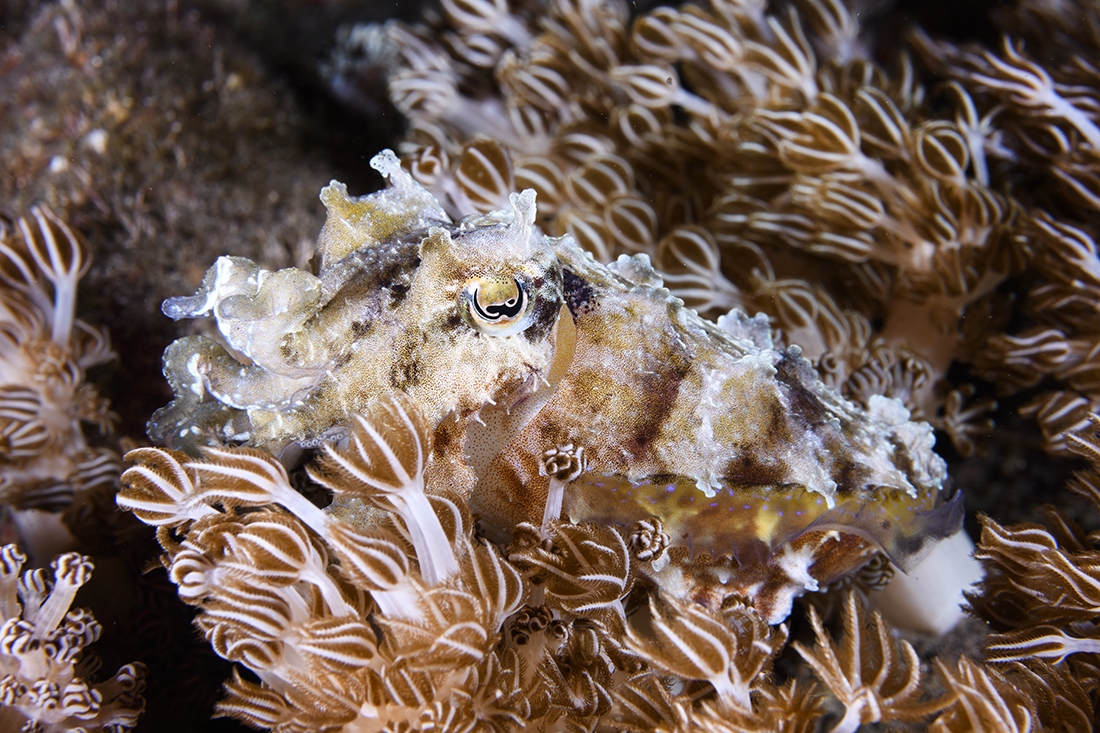


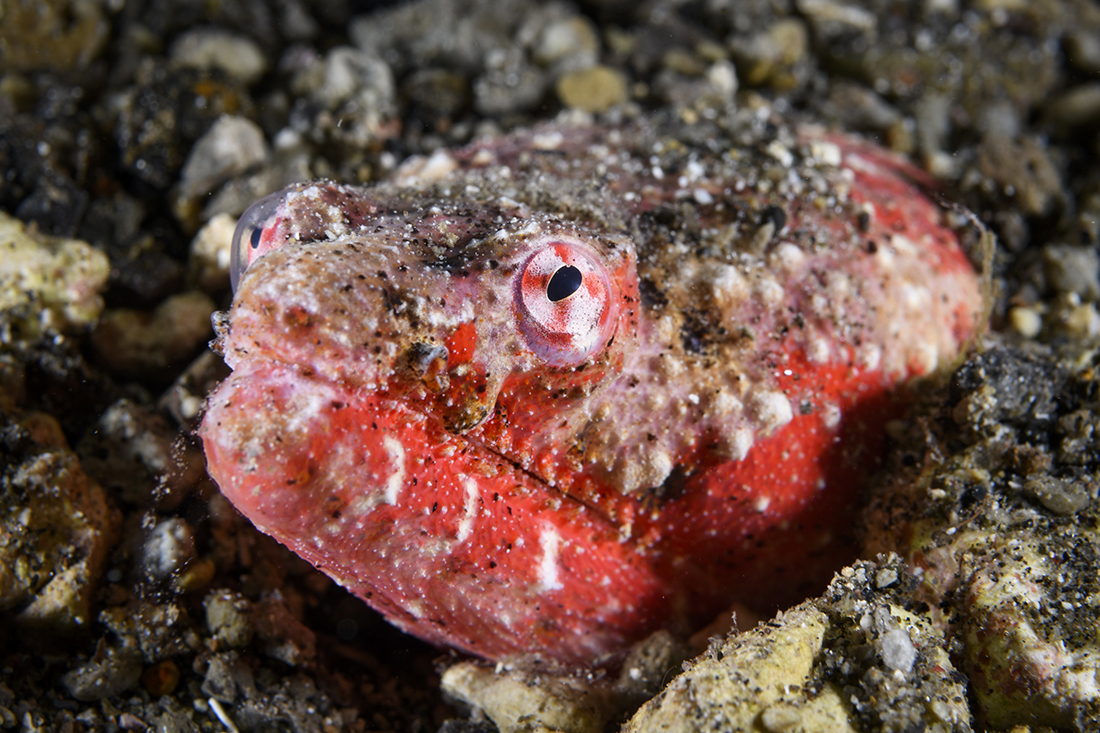
In addition, the night’s tally of one lacy and three paddle-flap Rhinopias in included a rather ornately colored spiny devilfish (Inimicus didactylus) which happens to be another variety of cryptic scorpionfish. And the list of finds didn’t end there. Besides a few small cuttlefish and Barred fin morays (Gymnothorax zonipectis), an emperor shrimp riding a Pleurobranch sea slug, the night provided us a very vivid orange colored painted frogfish (Antennarius pictus), a stargazer and crocodile snake eel peering up from the sand, and one gorgeous red Spanish dancer (Hexabranchus sanguineus) out for a stroll! Spanish dancers are not just any sea slug they are largest nudibranch in the dorid family that can grow to 10 inches / 25.4 cm in length.

Beforehand I was told by the Arenui’s dive guides that when it comes to muck dives, Mucky Mosque delivers. Seeing it for myself, I have to agree.
